The forest felt different today.
Not loud. Not busy.
Just different.
The air was softer, and the snow had melted off most of the path. In its place, the ground was dark and damp.
Alex walked beside Mr. Owl and watched his boots press into the mud.
Squish. Squish.
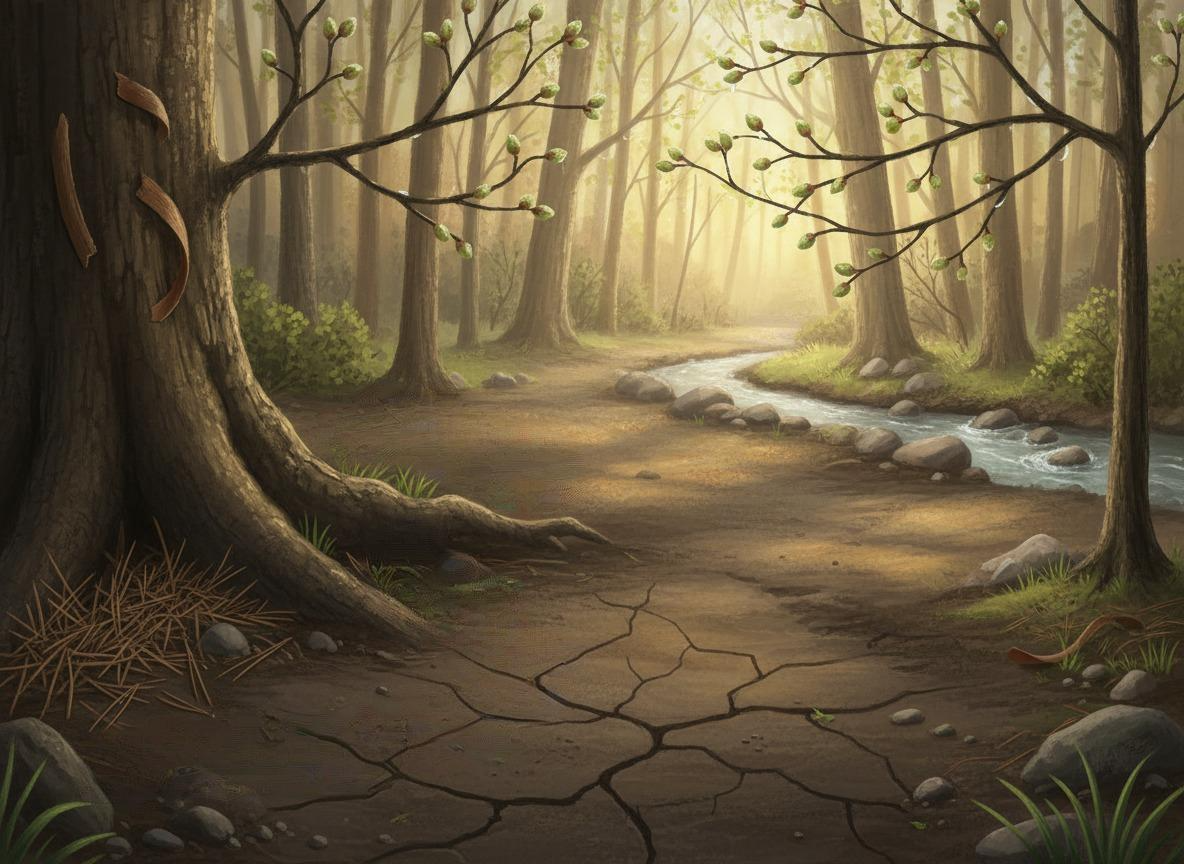
Near the creek, the mud looked smooth in some places. In others, it had thin cracks running through it, like pieces of a puzzle.
Alex pointed. “Why did the mud break?”
Mr. Owl perched on a low branch. “It was wet. Then the sun and wind dried the top. When mud dries, it can pull apart.”
Alex leaned closer. The cracks made tiny shapes—little squares and triangles.
He stepped carefully around them so he wouldn’t break the pattern.
A little farther along the path, Alex stopped again.
A thin, wiggly line ran across the mud.
It wasn’t a crack. It wasn’t a stick.
It looked like someone had dragged a piece of wet string through the dirt.
Alex crouched down. “What is that?”
Mr. Owl glided to a branch closer to the ground. “Look closely. What do you notice?”
Alex leaned in until his nose was almost over the line.
It was slightly raised in places, with tiny bumps along it. Beside it were little dots, like crumbs of dirt.
“It’s bumpy,” Alex said. “And there are little pieces.”
Mr. Owl nodded. “That is a worm trail.”
Alex’s eyes widened. “A worm was here?”
“Yes,” said Mr. Owl. “When the ground is wet and the air grows warmer, worms come closer to the top of the ground. They move through the soil and the mud.”
Alex looked around as if he might see the worm nearby.
He didn’t.
But the line was there.
Proof.
Alex pointed at the tiny crumbs beside it. “What are those?”
“Bits of soil,” Mr. Owl said. “Worms move the soil as they travel. They help mix it and make space for air and water. That helps the ground stay healthy.”
Alex studied the wiggly line again.
It was small, but it felt important.
“Like the forest is waking up,” he said.
Mr. Owl gave a soft hoot. “Little by little.”
They kept walking.
A breeze moved through the trees, and Alex noticed a small pile of pine needles tucked against a root. They were lined up neatly in a thin row.
“It looks like a tiny broom swept them there,” Alex said.
Mr. Owl blinked slowly. “The wind can gather light things together. It pushes them until they catch on something.”
Alex liked that idea. The wind had no hands—but it could still move things.
A few steps later, Alex noticed something else.
At the base of a tree were thin pieces of bark, scattered like puzzle pieces on the ground.
Alex picked one up and rubbed it between his fingers. It felt dry and rough.
“Did the tree break?” he asked.
Mr. Owl shook his head gently. “Bark can loosen and fall as a tree grows. Sometimes birds or insects disturb it while searching for food.”
Alex placed the bark piece back where he found it.
Then he looked up.
Tiny buds lined the branches above him. They were round and tight. Some looked shiny, as if covered with a thin coat.
Alex reached toward one—then stopped and simply looked.
“They’re still closed,” he whispered.
Mr. Owl nodded. “Buds protect the new leaves inside. They wait for warmer days.”
Alex looked back down at the path.
Cracks in the drying mud.
A worm trail crossing the ground.
Pine needles gathered by the wind.
wBark pieces beneath the tree.
Buds waiting on the branches.
It wasn’t one big change.
It was many small ones.
Alex stood and took a slow breath.
“I like this,” he said. “It’s like the forest is leaving clues.”
Mr. Owl gave a soft hoot. “And you are learning how to read them.”
Alex smiled and followed the path onward, watching the ground and the branches, ready to notice the next small sign of spring.
What have you seen today?
Have you ever seen a wiggly line in mud, or tiny crumbs of soil on the ground? What do you think made it? What is one small sign of spring you’ve noticed where you live?

Leave a Reply
You must be logged in to post a comment.